Short answer: upstairs stays cold because the thermostat downstairs switches the boiler off as soon as the living room is warm. Smart radiator valves do let upstairs call for heat, but then the underfloor heating downstairs warms up as well. Real zoning needs a zone valve in the supply pipe of the underfloor heating, controlled by its own receiver. Updated 25 October 2026.
Why I cannot heat upstairs while downstairs is already warm
Many homes have one thermostat in the living room. That thermostat is wired to the boiler and decides whether the boiler may run or not. Downstairs there is underfloor heating, and the thermostat is set to 21 degrees, for example.
As soon as 21 degrees is reached, exactly what you set happens: the thermostat stops sending heat demand to the boiler. The boiler switches off. Upstairs you can turn the radiators up as much as you like, but no hot water arrives. Not because the radiators are broken, but simply because the boiler gets no heat demand. This problem often occurs when heating upstairs with underfloor heating in one installation.
Why this is logical behaviour of the installation
Your thermostat does not think in floors or rooms. It thinks only one thing: the living room is 21 degrees, and that is exactly what you want. If it switches the boiler on now (sends heat demand), it will get warmer than 21 degrees. That is not how it is set, so it does nothing.
For the thermostat, “upstairs” does not exist. It only sees its own measured temperature. That is why upstairs cannot heat as long as downstairs has no heat demand.
Why people then switch to EvoHome or Tado
At this point, many people think: I need zone control. They switch to systems such as Honeywell EvoHome or Tado, because these promise:
- control per room
- smart radiator thermostats
- separate schedules
And that is true. But only partly.
What changes technically with smart radiator thermostats
When you fit smart radiator thermostats on the radiators upstairs, something important happens. These thermostats can:
- open a radiator locally
- and pass a heat demand on to the system
That heat demand goes through a wired thermostat or a wireless receiver connected to the boiler. Result: upstairs can now send a heat demand to the boiler. That is a step forward.
Why the problem then shifts downstairs
As soon as upstairs asks for heat, the boiler starts. The pump starts sending hot water around the whole circuit. And this is where it goes wrong. The underfloor heating downstairs is on the same circuit as the radiators. And in very many homes there is no shut-off valve between the boiler and the underfloor heating manifold. That means: as soon as the boiler runs, hot water flows through the underfloor heating.
Why the living room suddenly reaches 24 or 25 degrees
The radiators upstairs can close. The smart thermostats do that neatly. But the underfloor heating cannot, because hydraulically it is always open. So: upstairs asks for heat, the boiler runs, the underfloor heating heats along and the living room keeps warming up.
The thermostat downstairs sees this too late, because underfloor heating reacts slowly. By the time it steps in, it is already too warm. This is exactly why people say: “When I heat upstairs, downstairs gets far too warm.”
The core of the problem in short
The problem is not the thermostat, the smart radiator thermostat or the boiler. The problem is this: the underfloor heating is not a zone that can be shut off. You can close radiators, but often not underfloor heating. As long as the underfloor heating can always heat along, real zone control is impossible.
What you need technically for real zone control
If you want upstairs to heat without downstairs, and downstairs not to heat along when upstairs asks for heat, you need to turn the underfloor heating into a real zone . There is only one way to do that.
Why a smart thermostat cannot replace this thermal mixing valve
Many underfloor heating manifolds have a thermal mixing valve with sensor. This valve is often mistaken for a control knob or zone valve, but it is neither. Its only function is limiting the water temperature in the underfloor heating. Through the sensor, it measures the temperature of the water in the manifold and mixes hot boiler water with return water until the set temperature is reached, for example 35 or 40 degrees.
What this valve does not do:
- it does not measure room temperature
- it does not control the boiler
- it does not open or close a zone
- it does not stop the water flow when there is heat demand elsewhere
Some people think a smart radiator thermostat can take over this function and so control the underfloor heating. That is technically not possible. A smart thermostat controls based on room temperature and is designed for radiators that react quickly. Underfloor heating is slow and is not controlled through a valve, but through water mixing and flow. Even if a smart thermostat fitted mechanically, it could not replace the function of this thermal mixing valve.
That is why the underfloor heating keeps heating along as soon as the boiler runs, regardless of smart thermostats elsewhere in the home. For real zone heating, the mixing valve does not need replacing; instead, the underfloor heating must be made able to shut off with a separately controlled zone valve. Only then can the underfloor heating really switch on or off per zone.
The only structural solution: a zone valve on the underfloor heating
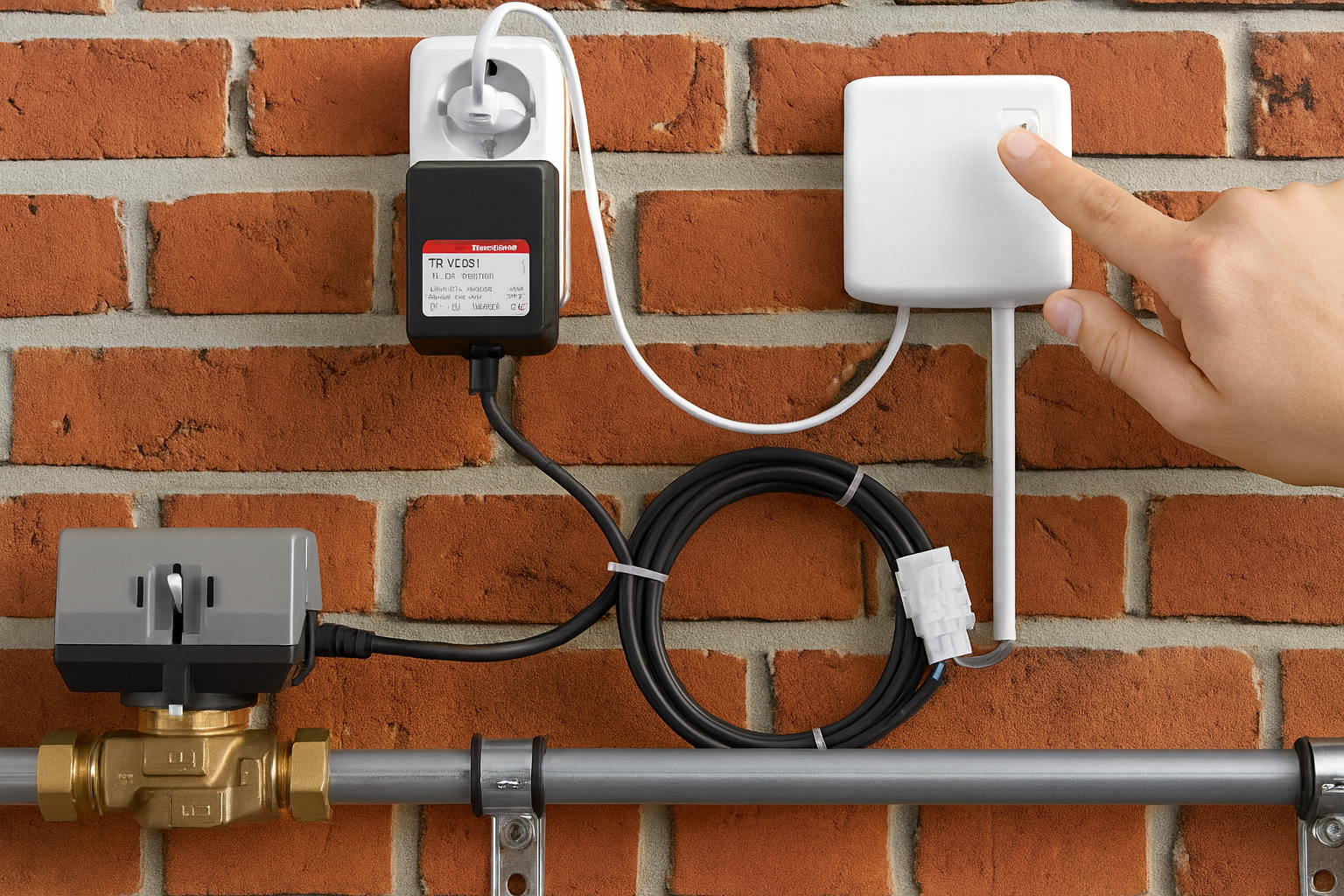
A zone valve needs to be fitted on the supply to the underfloor heating manifold. That valve does the following:
- heat demand downstairs → valve open
- no heat demand downstairs → valve closed
This lets the underfloor heating be “off”, just like a radiator.
Why you need a separate receiver for this
A zone valve needs to be controlled. Not by the radiator thermostats, but by its own zone controller. That controller:
- receives heat demand from the living room zone
- opens or closes the zone valve
- can also send heat demand to the boiler itself
This creates a separate zone for the underfloor heating.
Tado X or an existing Tado V3+ system: what works with what?
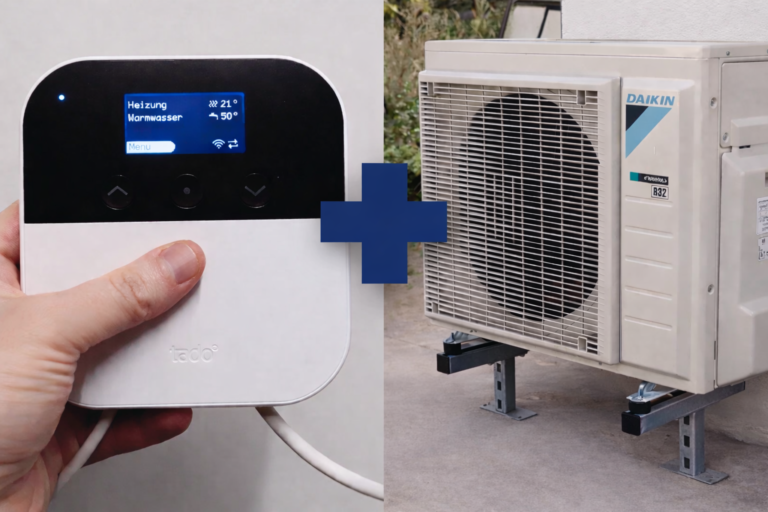
With Tado X there are two ways to do this. Wireless: one Receiver X on the boiler and a second Receiver X on the zone valve of the underfloor heating. If there is already a thermostat wire to the room, a wired Thermostat X goes on the boiler and one Receiver X on the zone valve. Tado X supports several zone controllers in one system. Each zone calls for heat on its own and opens and closes on its own.
Do you already have a Tado V3+ system? A separate underfloor heating zone is possible there too: a wired Smart Thermostat V3+ on the zone valve and the Wireless Receiver V3+ on the boiler. Please note: V3+ and X cannot be combined in one system. We install Tado X.
Want to know more about the possibilities and limits of Tado combined with underfloor heating and radiators? See our page on Tado smart thermostats.
Why this problem is so common
This is not a user error. In older homes, zone control was never planned, and in many new-build homes it is still not done properly. As soon as you want to control per floor, you run into this design flaw.
Frequently asked questions about zone control and underfloor heating
Why can't I heat upstairs while downstairs is already warm?
That is because many installations have one central heat demand. As soon as the underfloor heating downstairs is up to temperature, the heat demand switches back, while the rooms upstairs are not yet warm enough. So it is not a fault, but logical behaviour of a system without real zone control.
Do smart radiator thermostats solve this problem?
Smart thermostats help to control radiators per room, but they cannot replace the thermal mixing valve of an underfloor heating system. For an underfloor heating circuit, you therefore need a zone valve with a separate receiver to control the zones truly independently.
What do I need for real zone control?
For structural zone control on underfloor heating, you need a zone valve that can open and close per circuit, controlled by a separate receiver. Combined with a system such as Tado X, you can then control the temperature per zone, something that is practically not feasible with a simple setup.
Why does the living room sometimes get too warm after adjusting?
If you increase the heat demand to get upstairs warm, downstairs keeps heating for longer. Without a zone valve, the living room then rises towards 24 or 25 degrees. Real zone control prevents this, because each zone stops as soon as it reaches its own target temperature.
Conclusion
You cannot heat upstairs because the thermostat downstairs switches the boiler off. With smart thermostats you can create heat demand upstairs, but then downstairs heats along. That happens because the underfloor heating is not a zone that can be shut off. The only technical solution is:
- a zone valve on the underfloor heating
- controlled by its own receiver
- within a system that supports several zones, such as Tado X
Want to know what this means for your home? Request a tado° quote, or first read which smart thermostat suits your home.