Je krijgt drie offertes voor een warmtepomp. De ene noemt 8 kW, de andere 12 kW, de derde 16 kW. “Liever iets te groot, dan heb je het in de winter zeker warm”, zegt een verkoper. Bij een warmtepomp is dat geen goed uitgangspunt. In dit blog lees je waarom een te grote warmtepomp duurder kan zijn en minder rustig draait, hoe je dat met een simpele som ziet, en wat je een verkoper vraagt.
Short answer
- Is the output of your old gas boiler a good guide? No. Many boilers were chosen on the large side. So first have someone calculate how much heat your home needs on a cold day.[1][2]
- What is wrong with too big? If your home needs less heat than the heat pump delivers at its lowest setting, it can keep switching on and off. That can cost efficiency and cause more wear. A larger unit can also cost more to buy.[2]
- How do you choose the right size? Ask for a heat loss calculation per room: it shows how much heat each room loses. Also ask what the unit's lowest setting is.
Can I keep the output of my old gas boiler?
Many people take the output of their old boiler as a starting point. According to Solar Magazine, gas boilers are often chosen on the large side to cover peaks, whereas the output of a heat pump should match what the home really needs.[1] The American energy agency NYSERDA says the same: do not choose the same output as the old unit, because boilers are often oversized too.[2]
What happens if the heat pump is too big?
A heat pump can turn its output down, but not to zero. If it is too big, then on an ordinary winter day it can still deliver more heat at its lowest setting than your home needs. It then keeps switching on and off. That can cost efficiency and cause more wear.[2] How that works exactly, with a worked example, you can read further down.
I am still going to insulate, what then?
If you insulate your roof in a few years or fit new windows, your heat loss goes down. A heat pump that fits exactly now can then become too big. NYSERDA advises including plans for the next 5 to 10 years in the calculation.[2] So pass your plans on to whoever calculates the output.
Is too small better then?
Too small is not good either: in a hard frost the home may not get warm enough without extra heating. That is why the output should come from a calculation, not from a rule of thumb or a feeling.[1]
Watch out with the subsidy too. A larger unit gets you more ISDE subsidy, but that does not make a larger unit the right fit.[8] The amounts are further down.
What we do and do not do
For a home of just over 300 m², the owner got two figures from two advisers: 15 kW and 20 kW. Neither was backed by a calculation. You then cannot say which of the two fits; perhaps neither. That is why we work like this:
- No output without a calculation. First the heat loss calculation per room, only then a kW figure in the quote.
- Checked in advance. For the unit we install, we have the importer check the output and the buffer tank before ordering.
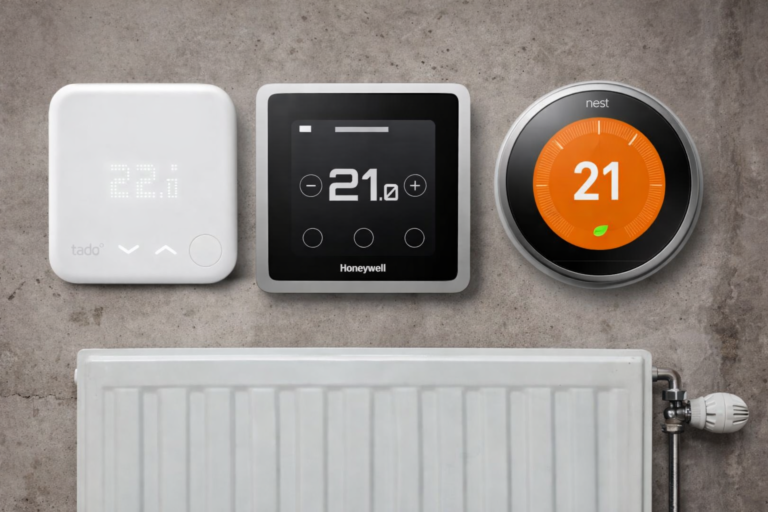
- Not controlled like a gas boiler. What we often see: every room thermostat switches the heat pump on and off itself. With a heat pump that modulates its output, that can cause short cycling and cost efficiency. We let the heat pump run on its own heating curve: it adjusts the water temperature to the outdoor temperature. The room thermostats then only control how much heat each room gets.
Questions you can ask a salesperson
- Which heat loss calculation is this output based on, and may I see it? Was it calculated per room?
- What is the minimum output of this unit, at which outdoor and water temperature, and when might it switch on and off often in my home?
- Have you taken into account the insulation I am still planning?
- Why this output and not one size smaller?
What do you do now?
- Do you already have a quote with an output in it? Ask the salesperson for the heat loss calculation per room that the figure is based on, and for the minimum output of the unit. If you have three quotes, put them side by side: which model, how much output on a cold day and how far the unit turns down, with the outdoor and water temperature included.
- Would you like us to take a look? Send us, via the contact form your floor plan, the year of construction and what you know about insulation and glazing. If you already have a calculation or quote, send it along. We check the room sizes on the drawing; if anything is missing, we will ask.
For those who want the details
Above is what you need to assess a quote. Below we go into the technical side: what happens inside the heat pump, the sum that shows whether it is too big, and the buffer tank. Read on if you want to know exactly how it works.
What exactly happens: short cycling
The output in kilowatts (kW) says how much heat a unit can deliver at any moment. A modern heat pump turns that output down, but not to zero. Every unit has a minimum output. If your home needs less than that minimum, the heat pump can switch on, deliver too much, switch off, and start again a little later. That is called short cycling.[2]
An oversized unit can affect efficiency, wear and purchase cost:
- Efficiency. Short cycling can lower efficiency. According to NYSERDA, efficiency can be up to 25 per cent lower during the hours it cycles. That American factsheet is mainly about air-to-air heat pumps; we did not find a Dutch measurement.[2]
- Wear. According to NYSERDA, frequent switching on and off can increase wear on the compressor, the fan and the valves.[2]
- Purchase. A larger unit can cost more to buy.[2]
How can I tell whether a heat pump is too big?
A heat loss calculation works out how much heat your home loses on a very cold day. In an example calculation under the Dutch guideline ISSO 51 that we read, an outdoor design temperature of -10 °C was used, adjusted to -8.5 °C for that building.[4] Below we calculate with -10 °C. On a milder day your home loses less heat, roughly in proportion to the difference between inside and outside.
Worked example
Say your home loses 6 kW at -10 °C outside and 20 °C inside. That is a 30-degree difference.
- The KNMI gives a long-term winter average of 3.9 °C for De Bilt.[6] We take that as our reference point. The difference with inside is then about 16 degrees. Your home then needs about 6 × 16 ÷ 30 = 3.2 kW.[5]
- A 16 kW heat pump can turn down to about 4.8 kW, according to the importer of the unit we install. At which outdoor and water temperature that applies was not stated; in the sum we keep the 4.8 kW constant.[3]
- That 4.8 kW is more than the 3.2 kW your home needs. In this example, this heat pump can therefore start short cycling at an average winter temperature. Only below about -4 °C does the home need more than 4.8 kW.[5]
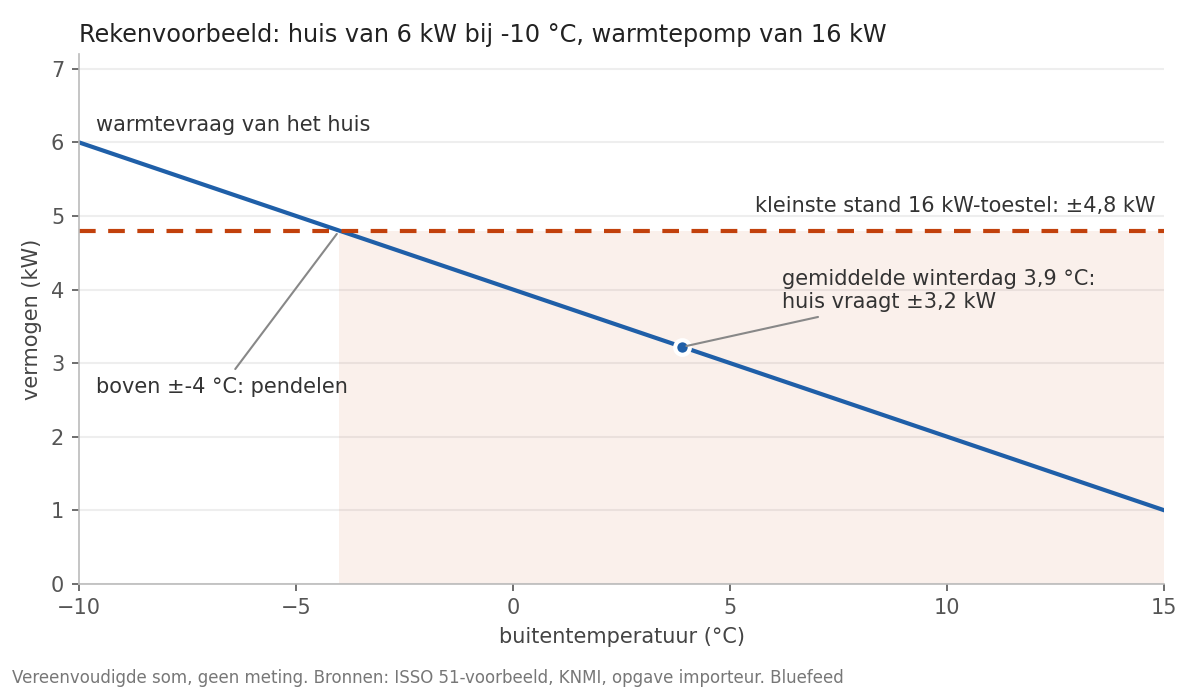
This is a simplified sum, not a prediction of how often a unit actually switches on and off. Sun, cooking and people in the home also provide heat. The sum shows what to look out for, not what happens in your home.
Choosing one size smaller only helps if that unit really turns down further. That differs per model and is not always in the brochure; for the 9 and 12 kW versions of the unit we install, we did not find it.[9] So always check the minimum output, with the outdoor and water temperature included.
Doesn't a buffer tank help, then?
A buffer tank is an extra tank of heating water. It gives the heat pump room to run longer each time. We size the tank on the minimum output of the unit and the run time we want per start. But a tank does not make an oversized unit smaller. id.nl therefore calls a buffer tank on an oversized heat pump “treating the symptoms”.[7] Start with the right output.
What we also do not do: an overflow, also called a bypass, next to the buffer tank. Such a bypass mixes hot flow water back into the return. That costs efficiency, and it does not solve an oversized unit.
Subsidy: the amounts
If you meet the RVO conditions, the ISDE for a first air-to-water heat pump in 2026 is € 1,025 plus € 225 per kW of eligible output, and € 200 extra with energy label A+++.[8] More subsidy does not make a larger unit the right fit: a larger unit can cost more to buy, and a higher minimum output can increase the chance of short cycling.[2]
How these figures came about: our own simplified sum with the -10 °C from ISSO 51, the KNMI winter temperature and the minimum output given by the importer; not a measurement in a real home. Ryan, Bluefeed
Sources (9)
- Solar Magazine, ‘Vlaams EPC verklapt voortaan of warmtepomp goed past’ (Flemish EPC will now show whether a heat pump fits), 4 August 2026: https://solarmagazine.nl/nieuws-zonne-energie/i44415/vlaams-epc-verklapt-voortaan-of-warmtepomp-goed-past (read 7 November 2026)
- NYSERDA (New York State energy agency), factsheet ‘Air Source Heat Pumps: Don’t Oversize’, July 2023: https://cleanheatconnect.ny.gov/assets/pdf/CHC-CON-ashp-oversize-fs-1-v1.pdf (read 7 November 2026). An American source, mainly about air-to-air heat pumps.
- Information from the Dutch importer of the unit we install, to us, September 2026 (not public): a 16 kW heat pump turns down to about 4.8 kW; temperatures were not stated.
- Example of a heat loss calculation under ISSO 51, leever.nl: https://leever.nl/wp-content/uploads/warmteverliesberekening_voorbeeld.pdf (read 7 November 2026)
- Our own simplified sum; see the worked example above. Not a measurement in a real home.
- KNMI, ‘Winter 2025-2026’: https://www.knmi.nl/nederland-nu/klimatologie/maand-en-seizoensoverzichten/2026/winter (read 7 November 2026)
- id.nl, ‘Hoeveel vermogen moet een warmtepomp voor jouw woning hebben’ (How much output should a heat pump for your home have): https://id.nl/energie-en-klimaat/klimaat-en-luchtkwaliteit/klimaatbeheersing/hoeveel-vermogen-moet-een-warmtepomp-voor-jouw-woning-hebben (read 7 November 2026)
- RVO, ‘ISDE: wat is er gewijzigd vanaf 2026?’ (ISDE: what changes from 2026?): https://www.rvo.nl/subsidies-financiering/isde/isde-wat-wijzigt-er-2026 (read 19 November 2026)
- Panasonic, brochure Aquarea T-CAP M and installation manual WH-WXG09/12/16ME8: no minimum output is given for the 9 and 12 kW versions. Product page with documents: https://www.aircon.panasonic.eu/BE_nl/product/t-cap-stand-alone-outdoor-m-series-1-phase-3-phase-r290/ (read 7 and 19 November 2026).