What is an EnergyHub and what does it offer your business? Short answer: an EnergyHub is a local partnership in which businesses align their generation, storage and consumption so they can do more within the existing grid capacity. It is worth considering where the grid is full and upgrading a connection takes a long time. Whether it pays off depends on the consumption profiles, the agreements and what the grid operator and energy supplier allow. Updated 26 October 2026.
The Dutch electricity grid is getting fuller in more and more places. This leads to grid congestion: businesses, institutions and projects cannot get a new or heavier connection. Since 1 July 2026, small consumers (up to and including 3×80 A) are also on a single waiting list, with no fixed lead time. That slows down sustainability measures and expansion.
An EnergyHub can then be a local alternative. By aligning generation, storage and consumption locally between several users, space can be freed up on the grid and projects can sometimes go ahead after all. In this article you will read what an EnergyHub is, how it works, who it may be interesting for and how to get started.
What is an EnergyHub?
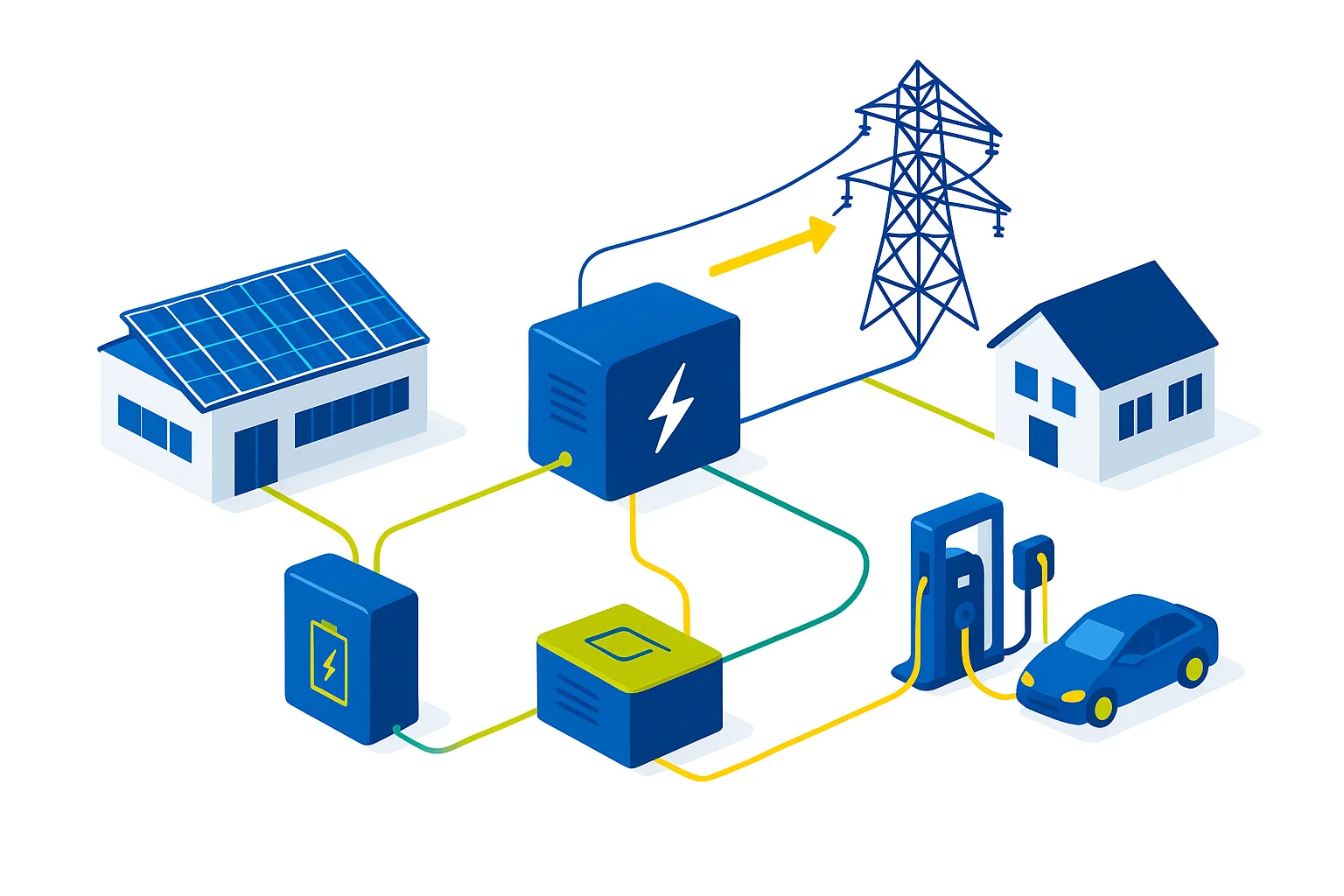
An EnergyHub is a local partnership of businesses, farmers, care institutions or households that organise their energy together. Usually each party keeps its own connection, but a shared platform makes data on generation, consumption and storage visible. This allows peaks and troughs in energy consumption and production to be balanced between the participants, and the group can respond together to moments of grid load or a surplus of renewable energy.
The idea behind it is simple: where one party has electricity to spare, another needs it. If control and storage really reduce the simultaneous peaks, the load on the local grid can decrease.
Good to know: sharing electricity between businesses runs through the energy supplier, a market party or an energy cooperative and involves administration and costs; sharing between customers of different suppliers will only become possible after a change in the law (expected in 2027). Also read our article on energy cooperatives.
How does an EnergyHub work?
If storage or suitable electric vehicles are part of the hub, an energy management system can direct available solar or wind power to them. When there is little generation, stored electricity is used instead or consumption is temporarily reduced. This can free up space on the local grid. The system gives participants insight into consumption and generation and controls according to their agreements, such as a maximum offtake per participant at busy times.
An important principle here is “peak shaving”: flattening the peaks in supply and demand. By aligning large consumers and producers, the outliers can become smaller and the connection capacity is used better. How much room that creates differs per location and follows from measurements of the consumption profiles, not from an assumption.
Who is an EnergyHub interesting for?
EnergyHubs are especially promising at locations where several energy users are close together and the grid is tight. Think of:
- Business parks with varied consumption profiles
- Agricultural clusters with a lot of roof space for solar panels
- Care and educational institutions
- New area developments where the grid still needs to be set up
An EnergyHub can be promising when the consumption and generation profiles complement each other: one business uses a lot during the day, the other mainly in the evening.
Benefits for businesses
For businesses, taking part in an EnergyHub can be interesting. You may find room to become more sustainable or to expand within the existing connection while an upgrade is on the waiting list. By storing energy locally and distributing it smartly, the peaks on your connection can become smaller and you use more of your own generation. The net-metering scheme ends on 1 January 2027; electricity fed back to the grid will then earn less than electricity you use yourself.
Participants can invest jointly in batteries, charging infrastructure and control systems. How the costs are shared and the payback period depend on profiles, tariffs and agreements.
Note for a shared battery: for a battery of 20 kWh or more at a business, a notification requirement is expected from 1 January 2028 (PGS 37).
Benefits for the Netherlands and the electricity grid
EnergyHubs can also help the Dutch energy system: less pressure on the regional grid and better use of locally produced electricity, so that sustainability measures can continue where the grid is full. One caveat: grid operators point out that sharing electricity with a free choice of supplier requires the same grid capacity. So a hub only helps if the peaks on the connections really become lower, through control and storage.
How do you start an EnergyHub?
Setting up an EnergyHub does not start with technology, but with cooperation. Broadly, it goes in a number of steps:
- Explore the possibilities: map out which parties nearby generate, use or want to store energy.
- Analyse the profiles: measure consumption, generation and peak load and request the connection capacity for each location.
- Design the solution: decide which storage, charging infrastructure and control are needed.
- Make agreements: set out how costs, revenues and control are shared and which party the sharing runs through.
- Implement and optimise: connect the systems and adjust based on data.
What Bluefeed does here
Bluefeed works on the building blocks of an EnergyHub: solar panels, battery storage, charging infrastructure and smart control. We start with a technical analysis of connection capacity, consumption, generation and peak load and investigate which solution is possible within the existing connection; we then work that out technically. The partnership, the contracts and the sharing of electricity run through an energy cooperative, the energy supplier or a market party.
Read more about solar and storage at sustainable energy solutions and energy advice and implementation. Curious how smart energy also works at home? Then also read our article on a future-proof smart energy system.
Frequently asked questions about EnergyHubs
Will I lose my own energy connection?
Usually each participant keeps their own connection; the hub adds a layer of agreements and shared control on top. Which form fits depends on the location and the grid operator.
Is an EnergyHub only for large companies?
No. Although many hubs arise on business parks, smaller businesses, farmers or institutions can also take part. The strength lies in the combination of different profiles, not in the size of one party.
Does an EnergyHub solve grid congestion?
Not by itself. Sharing on paper does not change the load on the cables. A hub helps if the peaks on the connections really become lower, through storage, control and agreements about who takes power when.
Vision for the future: together towards a smart and resilient energy system
The energy transition calls for new forms of cooperation and smart technology. EnergyHubs can be a building block in that: locally organised, digitally controlled and sustainably designed. Want to know what fits your location within the existing connection? Start with an analysis of consumption, generation and connection.