You have solar panels and you hear that net metering in the Netherlands ends on 1 January 2027. You start looking at a home battery and see two kinds: a battery with a plug, and a battery that is wired permanently into your installation. The leaflets mostly mention kWh. The real difference lies elsewhere: in what changes in your installation, how much power you draw in the evening and what you want the battery to do.
Short answer
- Are your panels and inverter working well, and do you want to start small? Then a plug-in battery on a dedicated circuit is the obvious choice. Your panels and inverter stay; the battery gets its own circuit.[2]
- Are you fitting new panels, does your inverter need replacing anyway, or do you draw a lot of power at once in the evening? Then a fixed battery is often a better fit.
- Want to borrow from the Warmtefonds? That is only possible for a battery connected by an installer, not for plug-and-play.[6]
Backup power for the whole house is not standard with either. And a battery does not fully make up for the end of net metering; more on that below.[13]
| Plug-in (example: Marstek Venus E 3.0) | Fixed | |
|---|---|---|
| Connection | plug, fitted by us on a dedicated circuit | wired into the installation |
| Your inverter | stays | stays, or becomes a hybrid inverter |
| Power | 800 W from a socket, up to 2.5 kW on a dedicated circuit after inspection and approval | per model; Enphase IQ 5P 3.84 kW |
| Phases | one phase per battery | can cover three phases |
| During a power cut | socket on the battery | with some systems, part of the house |
| Warmtefonds | no | yes, borrow up to € 8,500 subject to conditions |
Figures from the manufacturers’ manuals and datasheets and the Warmtefonds conditions.[2][3][4][5][6]
1. What a plug-in battery is
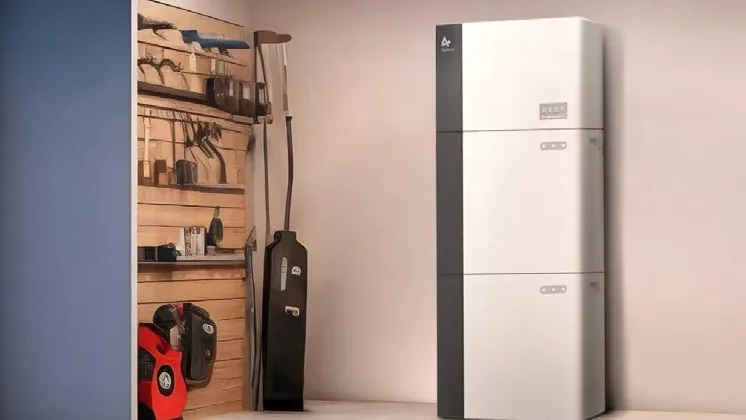
A plug-in battery has an ordinary plug and its own inverter inside the casing. It sits alongside your existing installation; your solar panels and your inverter stay as they are. With most models the battery uses a P1 meter on your smart meter to follow what your house uses and feeds back. Whether it charges or discharges depends on the settings and how full it is.
One example is the Marstek Venus E 3.0: 5.12 kWh, of which about 4.6 kWh is usable. From an ordinary socket it delivers 800 watts. On a dedicated circuit in the consumer unit it delivers up to 2.5 kW, and the manufacturer only unlocks that after the installation has been inspected and approved. That is why we always connect a plug-in battery to a dedicated circuit.
2. What a fixed home battery is
A fixed home battery has no plug. It is wired in permanently, in one of two ways:
- With its own battery inverter next to your existing inverter. Your panels stay as they are.
- Behind a hybrid inverter that manages both your panels and the battery. Whether your old inverter can stay depends on your installation.
Power differs per model; the Enphase IQ 5P, for example, delivers 3.84 kW. With a three-phase connection a fixed battery can supply all three phases. A plug-in battery supplies one phase and also works with a three-phase connection. If you want to supply all three phases, Marstek says you need one battery per phase, each on its own circuit.
3. Four questions that decide the choice
- Is your inverter still working? Then a plug-in battery can be added without replacing your inverter. If you are fitting new panels, or your inverter needs replacing anyway, a fixed battery behind a hybrid inverter may suit you better. Which one it becomes depends on your installation and your consumption.
- How much power do you draw at once in the evening? On a dedicated circuit a Venus E 3.0 delivers up to 2.5 kW, after inspection and approval. If your heat pump, charging point and induction hob all run at once in the evening, we assess which power level suits you based on your installation and consumption.
- Do you want power when the grid goes down? The Venus E 3.0 has a socket on the battery itself, up to 2.5 kVA; by default your house does not switch over automatically. With some fixed systems part of your house keeps running via separate backup circuits. If so, that is stated in the quote. Automatic backup for the whole house is not standard with either.
- Want to borrow from the Warmtefonds? The Warmtefonds lends up to € 8,500 for a home battery, but only if an installer connects it; the fund excludes plug-and-play batteries. Read about the conditions in our blog about the promise and the loan.
4. The catches with both
- Usable is less than it says on the box. Compare the price per usable kWh.[7] And some energy is lost when charging and discharging: in real-world tests of the Venus E 3.0, 79 to 85 per cent came back.[8]
- The location. The NIPV (Dutch Institute for Public Safety) advises a separate room away from the living room, bedrooms and escape route, with a smoke alarm; this is advice, not law.[9] Not every plug-in battery can go in a cold shed; according to Marstek, the Venus E 3.0 works from -20 to +55 °C.[3][7] We install it in a sheltered, frost-free spot.
- Notify. Your insurer (a fixed battery usually falls under buildings insurance, a loose one more likely under contents insurance) and your grid operator via energieleveren.nl.[10][11]
- Warranty. We are a Marstek partner. A Marstek Venus E that we install according to the manual has a 10-year warranty in the Netherlands. Your statutory rights against the seller still apply.[15]
- Your connection. A battery does not solve a grid connection that is too small.[12] You pay 21 per cent VAT on both.[11]
5. And what does it save?
That differs per house and per energy contract. An independent field trial by CE Delft for the Dutch homeowners’ association Vereniging Eigen Huis followed 13 households for a year: a battery does not fully make up for the end of net metering, and in two set-ups the payback period was between 6.5 and 22 years. The trial’s advice: choose a battery that matches your daily surplus, not the biggest one.
The ACM (the Dutch consumer and markets authority) calls a fixed payback period or “without a battery you lose out” a sign of misleading sales. Using your own consumption and feed-in, we calculate an indication for you, just as with our energy advice.
6. Five questions for a salesperson
- How many kWh are usable, and what does the battery cost per usable kWh?
- Does it plug into an existing socket or go on a dedicated circuit, and who checks the installation?
- How much power does it deliver in the evening, and is that enough for what I have running at the same time?
- How long is the manufacturer’s warranty, and what do I need to do to keep it?
- Do you calculate the savings with my own meter data, or with a fixed payback period?
How we choose
Working panels: then we check whether a plug-in battery on a dedicated circuit suits your installation and your evening consumption. We supply and install these ourselves; we do not install a battery you bought elsewhere. If a new circuit is needed, the costs are listed separately in the quote.
New panels, a high evening peak or backup power for part of your house: then we check whether a fixed battery fits. If your installation is suitable and the work can be scheduled, we arrange it from proposal to handover. Not sure? Do the home battery check: with a photo of your consumer unit we check whether a quote is possible without a visit.
How these figures came about: capacities and power ratings come from the manufacturers’ datasheets and manuals; the efficiency from users’ real-world tests; the payback period from the CE Delft and Vereniging Eigen Huis field trial. The date each source was read is listed below.
Sources
- Dutch government (Rijksoverheid), net metering scheme ends 1 January 2027. rijksoverheid.nl, read 29-10-2026.
- Marstek, Venus E installation manual NL (version 22-06-2026): 800 W via the plug, up to 2.5 kW after inspection and approval. Read 01-10-2026.
- Marstek, Venus E 3.0 datasheet (5.12 kWh, 2.5 kVA backup via the socket on the battery) and Venus E user manual 12-2025 (-20 to +55 °C). Read 09-10 and 02-11-2026.
- Enphase, IQ Battery 5P datasheet (3.84 kW). Read 25-09-2026 (knowledge base r258).
- Marstek Netherlands, three-phase FAQ: one battery per phase, each on its own circuit. marstek.nl, read 01-10-2026.
- Nationaal Warmtefonds, home battery: maximum € 8,500, connected by an installer, no plug-and-play. warmtefonds.nl/particulieren/energiebesparende-maatregelen/thuisbatterij, read 12-11-2026.
- Consumentenbond (Dutch consumers’ association), ‘Best plug-in home battery’ (updated 06-10-2026): capacity never fully usable, some models not suitable for a shed or garage. Read 01-11-2026.
- Real-world efficiency Venus E 3.0 79-85 %: thuisbatterijgids.net (6-month test) and community.home-assistant.io. Read 09-10-2026.
- NIPV, ‘Home batteries and fire safety’ (10-12-2024), pp. 31-35: separate room and smoke alarm to NEN 2555. Read 01-11-2026.
- Dutch Association of Insurers (Verbond van Verzekeraars), ‘Home battery not automatically insured’ (20-08-2026). verzekeraars.nl, read 29-10-2026.
- Dutch Tax Administration (Belastingdienst), VAT on home batteries 21 %, read 29-10-2026; Netbeheer Nederland, registration via energieleveren.nl, read 30-09-2026.
- Techniek Nederland, white paper on home batteries and grid connections (a battery does not solve a connection that is too small). Read 25-10-2026.
- CE Delft for Vereniging Eigen Huis, ‘Home battery field trials’ (January 2026), summary pp. 6-7. Read 29-10-2026.
- ACM/ConsuWijzer, ‘Stop het gesprek’ (‘End the conversation’) campaign (updated 02-11-2026). consument.acm.nl/stop-het-gesprek, read 03-11-2026.
- Marstek Venus E warranty: 10 years in the Netherlands when installed by a Marstek partner according to the manual (confirmation from our supplier SolarDeals, 12-11-2026; warranty terms marstekenergy.com/nl-nl/pages/warranty, read 08-11-2026).